Solar desal system produces drinkable water quickly without clogging

Researchers have developed a new solar-powered desalination system that produces high amounts of drinkable water and uses a technique inspired by the ocean to avoid the problem of salt clogging. Scaled up, the system could provide enough drinking water… Continue reading Solar desal system produces drinkable water quickly without clogging

Diabetes-treating implant produces oxygen to support islet cells

The current version of the device is about the size of a US quarter-dollar coin – a version for use in humans may be more around the size of a stick of chewing gum

Daily insulin injections are painful and inconvenient, which is why scientists are developing implants that treat diabetes without any need for needles. A new one looks particularly promising, as it produces oxygen to feed onboard islet cells.

Continue Reading

Category: Medical, Science

Tags: , , , , ,

Continue reading Diabetes-treating implant produces oxygen to support islet cells

Smart pill uses luminescing bacteria to diagnose gut problems

Not only are colonoscopies invasive and uncomfortable, they may also miss gut-problem-related biomarkers that are only present in the body for a short time. A new “smart pill” is designed to address such shortcomings, utilizing live light-up bacteria.C… Continue reading Smart pill uses luminescing bacteria to diagnose gut problems

Drug-delivery implant thwarts scar tissue by being a moving target

While we’ve heard about a number of drug-dispensing medical implants, most of them have the same drawback – they end up getting covered in scar tissue. An experimental new one avoids that problem by changing shape as the tissue starts to form.Continue … Continue reading Drug-delivery implant thwarts scar tissue by being a moving target

New cloud gaming tech from MIT and Microsoft keeps video and audio in sync

Researchers have developed a new cloud gaming system that uses low-level white noise to accurately synchronize separated audio and video streams. The unique approach let gamers see and hear things at the right time, even with poor microphone quality or… Continue reading New cloud gaming tech from MIT and Microsoft keeps video and audio in sync

New molecule slams the brakes on Alzheimer’s disease inflammation

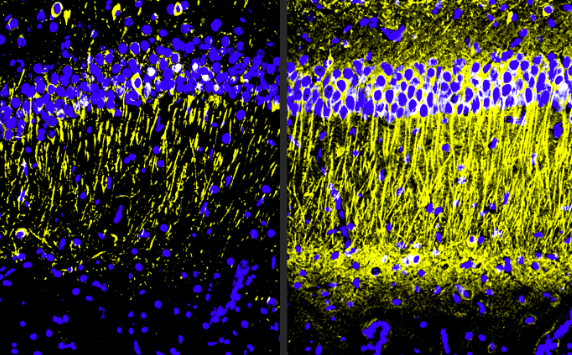
The brains of Alzheimer's model mice treated with A11 (right) showed more tubulin (yellow), a marker of neuronal health, compared to the untreated mice (left)

In an effort to find new treatments to halt the progression of Alzheimer’s disease, scientists at The Picower Institute for Learning and Memory at the Massachusetts Institute of Technology (MIT) have landed on a molecule that can improve memory by putting the brakes on a process that causes brain inflammation.

Continue Reading

Category: Medical, Science

Tags: , , , , , , ,

Continue reading New molecule slams the brakes on Alzheimer’s disease inflammation

Microscopic magnetic beads could quickly detect pathogens

Dynabeads are commercially available microscopic magnetic spheres which scientists use to isolate certain types of cells and proteins. Now, MIT researchers are developing a method of using the beads to quickly spot pathogens in drinking water or blood … Continue reading Microscopic magnetic beads could quickly detect pathogens

Invisible QR codes embed object data into infrared tags

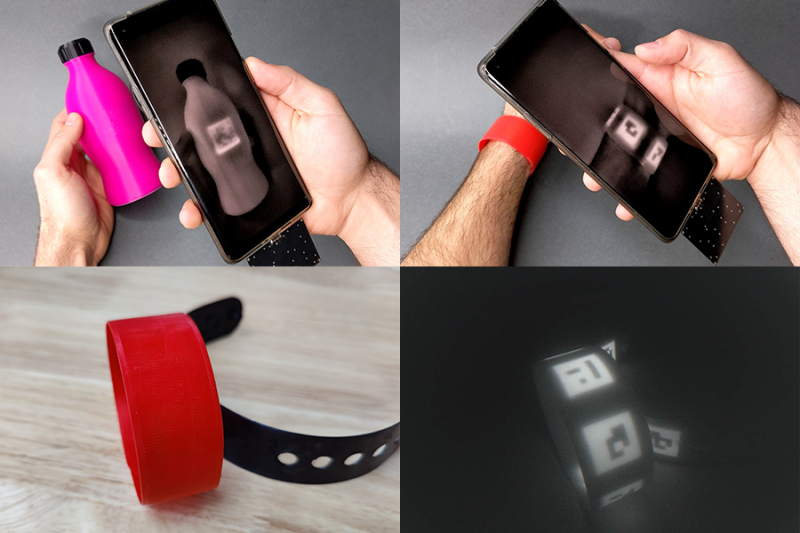
Barcodes and QR codes feel like they’re everywhere nowadays, but they don’t have to be. Scientists at MIT have developed an invisible tagging system called BrightMarker, which embeds fluorescent tags into objects that can be viewed and tracked through … Continue reading Invisible QR codes embed object data into infrared tags

Fluorescent Filament Makes Object Identification Easier

Four images in as many panes. Top left is a fuchsia bottle with a QR code that only shows up on the smartphone screen held above it. Top right image is A person holding a smartphone over a red wristband. The phone displays a QR code on its screen that it sees but is invisible in the visible wavelengths. Bottom left is a closeup of the red wristband in visible light and the bottom right image is the wristband in IR showing the three QR codes embedded in the object.

QR codes are a handy way to embed information, but they aren’t exactly pretty. New work from MIT’s Computer Science and Artificial Intelligence Laboratory (CSAIL) have a new way to …read more Continue reading Fluorescent Filament Makes Object Identification Easier

Quantum rods on DNA scaffolds could boost future VR displays

Move over, quantum dots – quantum rods could be the next big display technology. These tiny sticks could improve 3D displays for VR headsets, and now engineers at MIT have overcome a logistical hurdle by arranging them onto a scaffold made of DNA.Conti… Continue reading Quantum rods on DNA scaffolds could boost future VR displays