Building an Actuator for a Walking Robot

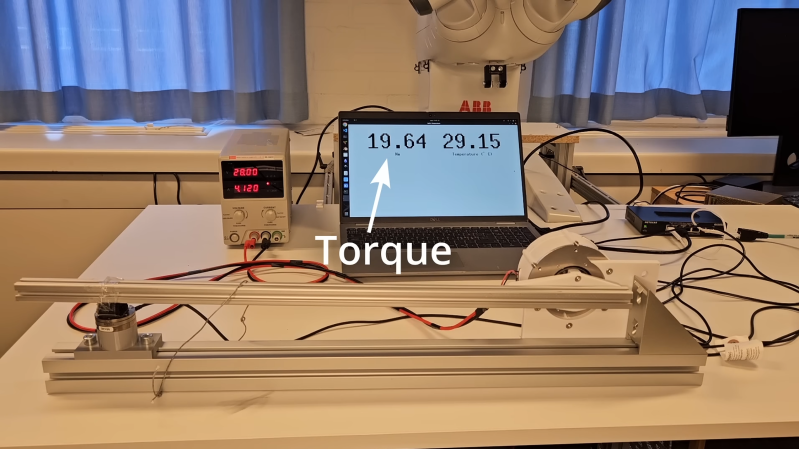
A test setup for an actuator is shown on a benchtop. A power supply connects to a cylindrical actuator, which has an arm pressing against a load cell. The load cell's output is shown on a computer screen, which is labelled "Torque".

Unlike biological systems, which can use muscles, robots that try to imitate them don’t have particularly fast, powerful, compact linear actuators available. This puts walking robots at a particular disadvantage, …read more Continue reading Building an Actuator for a Walking Robot→

Continously Extruding 3D Printed Tubes with Compressed Air

[Jan] of [Roetz 4.0] has a unique approach to multi-material 3D printing: he’s designed an extruder which takes two different materials and extrudes one as a shell around the other. …read more Continue reading Continously Extruding 3D Printed Tubes with Compressed Air→

Reading a Thermocouple with Mercury and a Potentiometer

A man's hand is shown adjusting a black Bakelite dial on the front panel of an instrument. The instrument is contained in a wooden box, and to the left of the box, a thermocouple is inserted into the flame of an alcohol burner.

If you’ve ever thought about the nomenclature of electrical components, potentiometer stands out as a strange name, etymologically suggesting something like a voltmeter. In fact, the component took its name …read more Continue reading Reading a Thermocouple with Mercury and a Potentiometer→

Strengthening 3D Prints with a Carbon-Fiber Epidermis

A man's hands are shown holding a broken 3D-printed hook. The hook has a loop and hook, in a number 9-shape. The hook portion has broken, exposing carbon fibers.

As strong and light as carbon fiber-epoxy composites are, the same can’t always be said of carbon-fiber reinforced 3D printer filaments. Of those that do improve over stock filament, the …read more Continue reading Strengthening 3D Prints with a Carbon-Fiber Epidermis→

2026 Frikkin Lasers Challenge: Measuring Nanometer-Scale Displacements with an Optical Cavity

A plastic device sits on a desk, with a computer display and an oscilloscope behind it. A fiber-optic cable runs from the device to a laser diode source.

Optical cavities – two mirrors arranged to reflect light multiple times between them – form the basis of lasers and certain optical filters. Since any angle between the two mirrors …read more Continue reading 2026 Frikkin Lasers Challenge: Measuring Nanometer-Scale Displacements with an Optical Cavity→