Thread on the OSI model is a lie

I had a Twitter thread on the OSI model. Below it’s compiled into one blogpost

Yea, I’ve got 3 hours to kill here in this airport lounge waiting for the next leg of my flight, so let’s discuss the “OSI Model”. There’s no such thing. What they taught you is a lie, and they knew it was a lie, and they didn’t care, because they are jerks.
You know what REALLY happened when the kid pointed out the king was wearing no clothes? The kid was punished. Nobody cared. And the king went on wearing the same thing, which everyone agreed was made from the finest of cloth.
The OSI Model was created by international standards organization for an alternative internet that was too complicated to ever work, and which never worked, and which never came to pass.
Sure, when they created the OSI Model, the Internet layered model already existed, so they made sure to include today’s Internet as part of their model. But the focus and intent of the OSI’s efforts was on dumb networking concepts that worked differently from the Internet.
OSI wanted a “connection-oriented network layer”, one that worked like the telephone system, where every switch in between the ends knows about the connection. The Internet is based on a “connectionless network layer”.
Likewise, the big standards bodies wanted a slightly different way of how Ethernet should work, with an LLC layer on top of Ethernet. That never came to pass. Well, an LLC layer exists in WiFi packets, but as a vestigial stub like an appendix.
So layers 1 – 4 are at least a semblance of reality, incorporating Ethernet and TCP/IP, but it’s layers 5 – 6 where is goes off the rails. There’s no Session or Presentation Layer in modern networks.
Sure, the concepts exist, but not as layers, and not with the functionality those layers envisioned.
For example, the Session Layer wanted “synchronization points” to synchronize transactions. Their model never worked, and how synchronization happens on the Internet is vastly more complex, with pretty much everybody designing their own method.
For example, how Google does Paxos synchronization at scale is a big reason for their success. It’s an incredibly tough problem for which it’s impractical to create a standard. In any case, you wouldn’t want it as a “layer”.
Sure, HTTP has “session cookies” and SSL has a “session” concept, but that doesn’t make these “session layer” protocols.
The OSI Presentation Layer (layer 6) is even more stupider. It was based on dumb terminals connected to mainframes. It was laughably out-of-date before it was even created. Back then, terminals needed to negotiate control codes and character sets.
It’s not simply “dumb terminals”, it’s the fact most everyone was still stuck on the concept that computer networks were for human-computer communications, rather than computer-computer communications.
The OSI Model they teach is a retconned (retroactive continuity) one that just teaches the TCP/IP model and calls it the OSI Model, and does major handwaving over the non-existent Session and Presentation layers.
Intermission: As a side not to this thread, let me answer this. It’s because Netscape invented SSL, and Microsoft hated Netscape, so forced the standards body to change the name to TLS.

Sure, HTTP has “session cookies” and SSL has a “session” concept, but that doesn’t make these “session layer” protocols.
I’ve never understand why the “Secure *Socket Layer*” was renamed to “*Transport Layer* Security” in the new version published in 1999, yet most people still seem to refer to it as “SSL” (including Qualsys!)

See Thomas W.’s other Tweets

It’s the same reason the French insist that “ISO” stands for “International Organization for Standardization”. I don’t put up with that nonsense, because I’m a troll.

You know what REALLY happened when the kid pointed out the king was wearing no clothes? The kid was punished. Nobody cared. And the king went on wearing the same thing, which everyone agreed was made from the finest of cloth.
The OSI Model was created by international standards organization for an alternative internet that was too complicated to ever work, and which never worked, and which never came to pass.

31 people are talking about this

So back to our story. I suppose “OSI Model” can be justified if if everyone taught the same thing, if it were all based on the same specification. But it isn’t. Everyone makes up their own version, like which where to put SSL. (The correct answer is “Transport Layer”, btw).
As for the question “in which layer does encryption belong?”, the correct answer is “all the layers”. And then some.
So this is a myth. The DoD mandated GOSIP, it never mandated TCP/IP. I mean, they did mandate working systems. Since GOSIP never worked, and TCP//IP was the only working alternative, that sorta mandated it.

Yea, I’ve got 3 hours to kill here in this airport lounge waiting for the next leg of my flight, so let’s discuss the “OSI Model”. There’s no such thing. What they taught you is a lie, and they knew it was a lie, and they didn’t care, because they are jerks.
Oh, but there was the whole GOSSIP stack that implemented it and was taken seriously – ’till the DoD mandated TCP/IP .

See Tim Panton’s other Tweets

What happened is that shipping systems came with an OSI stack that sometimes would get communication between two systems if they were the same vendor, but also TCP/IP for when things had to work.
You still see OSI nonsense in industrial control systems (port 102 = OSI Transport Layer on top of TCP). That’s because regulatory bodies are stronger in those areas, able to force bad ideas on people no matter how unworkable.
Morons call for “realpolitik”, that we could solve problems if only government had the will to overcome objections. But a government with enough political power to overcome objections is how we get bad ideas like OSI.
My first time pentesting a powerplant was sniffing traffic, finding TCP/102 …. and within an hour having an ASN.1 buffer overflow in a critical protocol that crossed firewalls.
So let’s discuss X.509 and LDAP, which both technically descend from the OSI standards bodies. DAP was a typical bloated, unimplementable OSI protocol, so that’s why we have “Lightweight DAP” or “LDAP”.

My first time pentesting a powerplant was sniffing traffic, finding TCP/102 …. and within an hour having an ASN.1 buffer overflow in a critical protocol that crossed firewalls.
This rant seems incomplete with some mention of The Directory and its surviving vestiges like X.509 and LDAP.

See Daniel Franke’s other Tweets

X.509 was a typical OSI standard written to serve the interests of big vendors instead of customers, who wanted to charge lots of money for certificates, hindering the adoption of encryption until LetsEncrypt put a stop to that nonsense TWO DECADES later.
You millennials have no concept how freakin’ long two decades is, and how that’s an unreasonable amount of time to not have free certificates for websites.
Here’s what you post-millenials/Gen-Z/whatever need to do. When you are in class and they start teaching the OSI model, stand up and shout “THIS IS BS” and walk out of the room. Better yet, organize your classmates to follow you.
“What is the OSI Model?” It’s the fact that the local network is independent from the Internet, and the Internet is independent of the applications that run on top of it. It’s the fact you can swap WiFi for Ethernet, or IPv6 for IPv4, or Signal for WatsApp

Yea, I’ve got 3 hours to kill here in this airport lounge waiting for the next leg of my flight, so let’s discuss the “OSI Model”. There’s no such thing. What they taught you is a lie, and they knew it was a lie, and they didn’t care, because they are jerks.
I did not understand everything so please correct me if I’m wrong – is OSI model a bunch of poorly separated responsibilities?

See Paweł Duda’s other Tweets

When we eventually move to IPv7, we won’t need to upgrade Ethernet switches. Ethernet and WiFi have no clue what are doing on top of them. Ancient alternatives like XNS or Novel or NetBEUI also work fine on the latest 802.11ax/WiFi6 router you just bought.
There are a few more subdivisions. Layer 1 (Physical) gets the raw bits transmitted on the wire (or into air). Layer 2 (Link) gets packets across your local network to the next router. Layer 3 (IPv4/IPv6) gets packets from one end of the Internet to the other.
Layer 4 (TCP/UDP) gets packets to one of many apps running on your machine to one of many apps running on the server. It may also retransmit lost packets. Layer 7 consists of a bunch of different protocols that services those apps.
No, the OSI Model doesn’t have its place. You can teach how layered networking works without teaching the OSI version. The OSI version messes it up rather than clarifying things.

Layers existed before the OSI Model. They didn’t invent the idea. They coopted and changed the idea. When you redefine it back again, you only confuse students. They can pass your test, but no some other test like the CISSP, because the answers won’t match. Because it’s made up.

Continue reading Thread on the OSI model is a lie

Posted in Uncategorized

Thread on network input parsers

This blogpost contains a long Twitter thread on input parsers. I thought I’d copy the thread here as a blogpost.


I am spending far too long on this chapter on “parsers”. It’s this huge gaping hole in Computer Science where academics don’t realize it’s a thing. It’s like physics missing one of Newton’s laws, or medicine ignoring broken bones, or chemistry ignoring fluorine.
The problem is that without existing templates of how “parsing” should be taught, it’s really hard coming up with a structure for describing it from scratch.
“Langsec” has the best model, but at the same time, it’s a bit abstract (“input is a language that drives computation”), so I want to ease into it with practical examples for programmers.
Among the needed steps is to stamp out everything you were taught in C/C++ about pointer-arithmetic and overlaying internal packed structures onto external data. Big-endian vs. little-endian isn’t confusing — it’s only made confusing because you were taught it wrongly.
Hmmm. I already see a problem with these tweets. People assume I mean “parsing programming languages”, like in the Dragon book. Instead, I mean parsing all input, such as IP headers, PDF files, X.509 certificates, and so on.
This is why parsing is such a blindspot among academics. Instead of studying how to parse difficult input, they’ve instead designed input that’s easy to parse. It’s like doctors who study diseases that are easy to cure instead of studying the ones hard to cure.
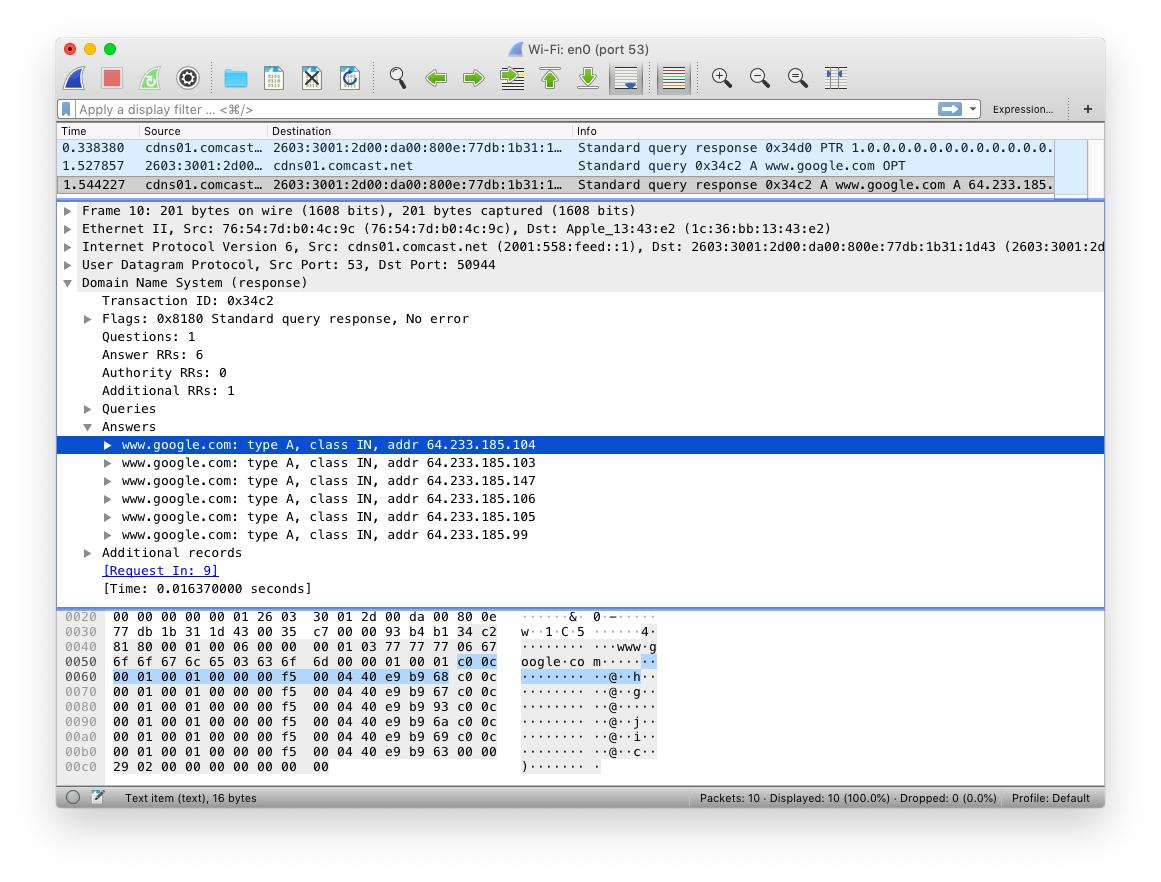
Parsing DNS is a good example. In a DNS packet, a name appears many times. Therefore, a “name” appearing a second time can instead just point to the first instance. This is known as “DNS name compression”. In this packet, “google.com” exists only once.
Any abstract model for “parsing” you come up with doesn’t include this compression step. You avoid the difficult parts to focus on the easy parts. Yet, this DNS compression feature is a common source of parser errors.
For example, you can create an infinite loop in the parser as a name points to another name that points back again. Multiple CVE vulnerabilities are due to this parsing bug.
As this tweet describes, “regex” is “hope-for-the-best” parsing. This is how most programmers approach the topic. Instead of formally parsing things correctly, they parse things informally and incorrectly, “good enough” for their purposes.

Things designed to solve the parsing problem haven’t, like XML, ASN.1, or JSON. First of all, different implementations parse the raw documents differently. Secondly, it’s only the first step, with lots remaining to be parsed.

We typically call those “wire formats”, “data formats”, “serialization”, etc. The word “parse” doesn’t exist in the TCP RFC, for example, and “parsing” a Word XML serialization into the AST is only the first step in converting it to an internal representation.

This is the enormous flaw of RPC or “Remote Procedure Call”, that promised to formally parse everything so that the programmer didn’t have to do it themselves. They could call remote functions the same as internal local ones with local data.
This lead to numerous exploits and worms of SunRPC on Unix systems at the end of the 1990s and exploits/worms of MS-RPC at the start of the 2000s. Because it’s a fallacy: external data is still external data that needs to be parsed.
For example, the “Blaster” bug was because a Windows computer name can’t exceed 16 characters. Since no internal code can generate longer names, internal code doesn’t keep double-checking the length, but trusts that it’ll never be more than 16 characters.
But then two internal components are on either side of RPC — remote from each other, where a hacker can change the bytes to create a longer name. Then you have a buffer-overflow, as an internal component receives what it thinks is an internally generated name, but isn’t.
This is a general problem: programmers don’t know what’s internal and what’s external. That’s the problem with industrial control systems, or cars. They define the local network as trustworthy and “internal” to the system, when it should instead be defined as “external”.
In other words, the Jeep hackers went from the Internet into the car’s entertainment system, and once there, were able to easily hack other components across the CAN bus, because systems treated input from the CAN bus as “internal” to the car, instead of “external” to the system.
Eventually we’ll need to move to “memory safe” languages like Rust, because programmers can never trust a buffer size is what it claims to be. In the meanwhile, all C/C++ code needs to respect the same sort of boundary.
That means we need to pass around the buffer size along with the buffer in API calls. It means that we need to pretend our language is memory safe. That means no more pointer arithmetic, and no more overlaying internal packed structures on top of external data then byte-swapping.
I know, I know. When you learned about “htons()” and “ntohl()” in your Network Programming class, you had an epiphany about byte-order. But you didn’t. It was wrong. You are wrong. They violate type safety. You need to stop using them.
Some jerk of a programmer working for BBN wrote these macros when adding TCP/IP to BSD in 1982 and we’ve suffered with them ever since. They were wrong then (RISC processors crash on unaligned integer access), and doubly wrong today (violates type safety).
You need to think of htons()/ntohl() macros are as obsolete as sprintf(), a function well-known for overflowing buffers because it has no ability to bounds-check, no concept of the length of a buffer it’s writing into.
Pointer arithmetic is also wrong. You were taught that this is idiomatic C, and you should always program in a programming language’s own idioms instead of using another programming language’s idioms (“A Fortran programmer can program in Fortran using any language”).
But pointer arithmetic isn’t idiomatic C, it’s idiotic C. Stop doing it. It leads to spaghetti code that really hard for programmers to reason with, and also hard for static analyzers to reason with.
As architects, we aren’t building new castles. We spend most of our time working with existing castles, trying to add electricity, elevators, and bringing them up to safety code. That’s our blindspot: architects only want to design new buildings.

Um, for the same reason architects design buildings that are easy to build. The examples you list- including DNS packet headers (and I’d like to add XML), were formats that were designed by humans. Generally by humans who didn’t know how to design inputs easy to parse.

Let’s talk about C for a moment. The Internet is written in C. That’s a roundabout way of stating that C predates the Internet. The C programming language was designed in an era were “external” data didn’t really exist.
Sure, you had Baudot and ASCII, standard external representation of character sets. However, since computers weren’t networked and “external” wasn’t an issue, most computers had their own internal character set, like IBM’s EBDIC.
You see a lot of HTTP code that compares the headers against strings like “GET” or “POST” or “Content-Type”. This doesn’t compile correctly on IBM mainframes, because you assumed the language knew it was ASCII, when in fact C doesn’t, and it could be EBDIC.
Post-Internet languages (e.g. Java) gets rid of this nonsense. A string like “GET” in Java means ASCII (actually, Unicode). In other words, the letter “A” in Java is always 0x41, whereas in C it’s only usually 0x41 but could be different if another charset is used.
Pre-internet, it was common to simply dump internal data structures to disk, because “internal” and “external” formats were always the same. The code that read from the disk was always the same as the code the wrote to the disk.
This meant there was no “parsing” involved. These days, files and network headers are generally read by different software than that which wrote them — if only different versions of the software. So “parsing” is now a required step that didn’t exist in pre-Internet times.
I’m reminded that in the early days, the C programming language existed in less than 12k of memory. My partial X.509 parser compiles to 14k. Computers weren’t big enough for modern concepts of parsing.

C was pretty type-unsafe then! “Prototypes” AKA function declarations with types were coming in only later in the 1980s, and CPP macros have only type “token-pastable string”.

Many want “provably correct” and “formal verification” of parsers. I’m not sure that’s a thing. The problem we have is that the things we are parsing have no format definition, and thus no way to prove if they are correct.

You think they formally defined. But then you try to implement them, and then you get bug reports from users who send you input that isn’t being parsed correctly, then you check the formal spec and realize it’s unclear how the thing should be parsed.
And this applies even when it’s YOU WHO WROTE THE SPEC. This is a problem that plagues Microsoft and the file/protocols they defined, realizing that when their code and specs disagree, it means the spec is wrong.
This also applies to Bitcoin. It doesn’t matter what the spec says, it matters only what the Bitcoin core code executes. Changes to how the code parses input means a fork in the blockchain.
Even Satoshi (pbuh) failed at getting parsers right, which is why you can’t have a Bitcoin parser that doesn’t use Bitcoin core code directly.
That issue is “parser differentials”, when two different parsers disagree. It’s a far more important problem than people realize that my chapter on parsers will spend much time on.

They •try•

Spotify had an amazing security bug around Unicode normalization.

Two different sections of their platform treated uppercasing/downcasing Unicode differently.

Unicode implementions are an inconsistent dumpster fire.

This is another concept I’ll have to spend much time on. Parsing was flexible in the early days (1970s/1980s) when getting any interoperability was a big accomplishment. Now parsers need to be brittle and reject ambiguous input.

Like the interop debates between “draconian error handling” versus “graceful degradation”, you’re going to introduce unanticipated trade-offs either way.

In the past, programmers didn’t know how to format stuff correctly, so your parser had to handle ambiguous input. But that mean how your popular parser handled input became part of the unwritten spec — parts everyone else struggled with to be compatible.
Modern work, from HTML to XML to DNS now involves carefully deprecating past ambiguous parsing, forcing parsers to be much stricter, defining correct behavior as rejecting any ambiguity.
In other words, in the old thinking, the parser should recognize this a vote for Franken, because that’s clearly the intent. In the new thinking, the parser should reject this input for not following the rules (two bubbles filled in).
I’m not including this in my chapter on “Parsers” only because it gets it own chapter on “State Machine Parsers”.

If you can model your input as a state machine and show that your state machine is correct, and then actually implement the state machine character by character, your parser should be bulletproof. Parsing input 1 character at a time is the only way to get it right.

Among the benefits of non-backtracking state-machine DFA parsers is that they don’t require reassembly of fragments. Reassembly is the source of enormous scalability and performance problems. You can see examples of how they work in masscan:

Which brings me to a discussion of “premature optimizations”, an unhelpful concept. Those who don’t want to do state-machine parsers will cite this concept as a reason why you shouldn’t do them, why you should worry about reassembly performance later.
On the other hand, prescriptions against premature optimization won’t stop you from doing pointer-arithmetic or structure/integer overlays, because you will defend such approaches as improving the performance of a program. They don’t, by the way.
Another unhelpful concept is the prescription against “magic numbers”. Actually, they are appropriate for parsers. “ipver == 4” is often much better than “ipver == IPV4”. If the source of a number is a separate spec, then defining the constant with a string has little benefit.
When I read the code, I have the specification (like the RFC) next to me. The code should match the spec, which often means magic numbers. If I have to hunt down things defined elsewhere, I get very annoyed, even in a good IDE where it’s just a few clicks away.
Don’t get me wrong. An enum {} of all possible values for a field, culled from multiple specifications and even non-standard vendor implementations, is also useful. The point is simply: don’t get uptight about magic numbers.
(Sorry for the length of this tweet storm — at this point I’m just writing down notes of everything that needs to go into this chapter, hoping people will discuss things so I get it right).

Continue reading Thread on network input parsers

Posted in Uncategorized