Sometimes techy details matter

How terrorists use encryption is going to become central to the Cryptowars 2.0 debate. Both sides are going to cite the case of Reda Hame described in this NYTimes article. On one hand, it shows that terrorists do indeed use encryption. On the other hand, the terrorists used TrueCrypt, which can’t be stopped, no matter how many “backdoor” laws the police-state tries to pass.

The problem with the NYTimes article is that the technical details are garbled. (Update: at the bottom, I correct them). Normally, that’s not a problem, because we experts can fill in the details using basic assumptions. But the technique ISIS used is bizarre, using TrueCrypt containers uploaded to a file-sharing site. This is a horrible way to pass messages — assumptions we make trying to fill in the blanks are likely flawed.


Moreover, there is good reason to distrust the NYTimes article. Small details conflict with a similar article in the French newspaper Le Monde from January 6. Both articles are based on the same confession by Reda Hame from last August.

For example, in discussing a training accident with a grenade, the NYTimes article says “Mr. Hame did not throw it far enough and was cut by shrapnel”. The Le Monde version says he tossed a stun grenade into a hut, then entered the hut, after which the grenade exploded. Stun grenades don’t have “shrapnel”. As the Le Monde article provides a direct quote, in the original French, it is more trustworthy:

“J’ai jeté la grenade dans la maisonnette, j’ai entendu une petite explosion, je suis rentré dans la maison, j’ai tiré dans trois cibles, puis la grenade a explosé”

Update: You would not throw a fragmentation grenade at a silhouette drawn on a wall, as the New York Times article describes. Throw it hard enough, and it just bounces back toward you. That’s not how it works. How it does work is how Le Monde describes, wait for the a stun grenade to go off before entering the room. The interrogation of Reda Hame lasted over 17 hours over multiple days, so you can imagine that at some point, he might have retold the story in a different way that might be closer to how the NYTimes describe it, thus accounting for the discrepancy. But this is doubtful, since this is not things work.

This is just one example, there are several other discrepancies with Le Monde. If the reporter gets these types of details wrong, how can we trust her on getting details of TrueCrypt correct?

For example, the reporter describes “a piece of paper showing his login credentials for TrueCrypt”, though a picture of TrueCrypt in the article shows the use of “keyfiles”. However, there’s no such thing as “login credentials for TrueCrypt”. It’s not a website or a computer, you don’t “login” to it. There’s no username. Instead, you have the passphrase to encrypt or decrypt the file. This is a perfectly fine detail to mess up in normal circumstances, because the average reader neither knows nor cares about the difference. But, since we techies are confused, and the reporter isn’t trustworthy about getting small details correct, the difference suddenly looms large. Maybe the reporter is confused about the difference between “login credentials” for TrueCrypt and login credentials for the file upload site.

She then goes on to describe “he was to upload the encrypted message folder onto a Turkish commercial data storage site”. Again, the terminology “encrypted message folder” in confusing. We assume it means the encrypted volume file, or the encrypted container file.

Also, what the heck is a “commercial data storage site”?? She goes on to tweet:

65/ They were using a program like TrueCrypt and then uploading the encrypted folder onto a website like https://t.co/Fnx7sNrTWy

— Rukmini Callimachi (@rcallimachi) March 29, 2016

What does this mean “like dosya.co”? Is it that site, or another one?

Also, that site is a “file sharing” site, not a “data storage” site. File sharing services are designed to share files, usually copyrighted materials like movies, music, porn, games, and ebooks. Data storage services like DropBox are designed for data storage. It’s an important detail, especially when you consider how intelligence services might be monitoring them for metadata.

I’ve written up a brief post on how intelligence services can track down terrorists using this technique, from either already collected metadata, or monitoring with their “XKeyScore” system. But I have little faith I’ve understood the details correctly from the NYTimes article, so there’s a good chance my post is just nonsense.

This isn’t an issue of being unnecessarily pedantic. I fully support the idea that reporters can use inelegant or “wrong” terminology in order to get the point across. The problem here is that I don’t think the reporter is getting the point across. I’m confused. Moreover, we know that the reporter has gotten other details wrong, when comparing similar passages with the Le Monde article, which directly quotes the subject.

Update: And now I’ve read one of the original French documents where the subject describes what was on that slip of paper recovered from his apartment, and confirmed my suspicion that the NYTimes article got details wrong.

The document I saw says the slip of paper had login details for the file sharing site, not a TrueCrypt password. Thus, when the NYTimes article says “TrueCrypt login credentials”, we should correct it to “file sharing site login credentials”, not “TrueCrypt passphrase”.

The original French uses the word “boîte”, which matches the TrueCrypt term “container”. The original French didn’t use the words “fichier” (file), “dossier” (folder), or “répertoire” (directory). This makes so much more sense, and gives us more confidence we know what they were doing.

The original French uses the term “site de partage”, meaning a “sharing site”, which makes more sense than a “storage” site.

MOST importantly, according the subject, the login details didn’t even work. It appears he never actually used this method — he was just taught how to use it. He no longer remembers the site’s name, other than it might have the word “share” in its name. We see this a lot: ISIS talks a lot about encryption, but the evidence of them actually using it is scant.

Update to this update: Runa Sandvik insists there are more than one pieces of paper in the story. Therefore, I could be talking about one piece of paper with “website login”, while the NYTimes article could be talking about another with “TrueCrypt password”:

@ErrataRob @thegrugq @csoghoian @josephfcox @moltke Re our conversation this morning; there are multiple pieces of paper in this story.

— Runa A. Sandvik (@runasand) April 1, 2016

But the original article references only a single piece of paper, “in his bag a piece of paper showing his login credentials for TrueCrypt”. It’s very strange that they are now claiming there existed separate pieces of paper that contained the website login credentials not mentioned in the original story.

She insists the reason for the bad technical terms was to make it more understandable to non-technical readers:

@ErrataRob That phrase may have been used to make it more understandable to all the non-technical readers.

— Runa A. Sandvik (@runasand) April 1, 2016

This, of course, is bogus. Nobody thinks that non-technical readers will understand “TrueCrypt login credentials” easier than “TrueCrypt password”. Non-technical users understand “password” much better than “credentials”.

Update: Somebody (@thegrugq) pointed out yet another discrepancy with a CNN story, describing the process of uploading to a file sharing site:

NYTimes: “basically a dead inbox”
CNN: “it operated like a dead letter drop”

The original phrase in French was “une boîte aux lettres morte” (a box of dead letters). The correct translation is “dead drop” (or “dead letter drop”), not “dead inbox”. The word “boîte” can also refer to a person’s inbox, so it’s a reasonable error to make if you don’t understand this is a specific spycraft term and are attempting to just translate the words according to French vernacular.

Continue reading Sometimes techy details matter

Posted in Uncategorized

How to detect TrueCrypt blobs being passed around

So, challenge accepted:

@ErrataRob you’re up for writing the blog post “detecting TrueCrypt/encrypt blob transfers” on the wire…

— the grugq (@thegrugq) March 29, 2016

tl;dr: The NSA should be able to go back through it’s rolling 90 day backlog of Internet metadata and find all other terrorist cells using this method.

From what we can piece together from the NYTimes article, it appears that ISIS is passing around TrueCrypt container files as a way of messaging. This is really weird. It has the has the property of security through obscurity, which is that it has the nice property of evading detection for a while because we’d never consider that ISIS would do such a strange thing. But it has the bad property that once discovered, it now becomes easier to track. With the keys found on the USB drive, we can now start decrypting things that were a mystery before.

We are going off of very little information at the moment, but let’s imagine some fictional things.

First, we need to figure out what is meant by a file or hosting site in Turkey. Such hosting sites are all over the place, as you can find with a little googling. Their primary purpose is to exchange copyrighted material (movies, music, games, ebooks) and porn. They are also a convenient way to host viruses that I’ll trick you to load in phishing emails.

Half of these appear to use SSL during file transfers. In such cases, there’s not much we can do in order to detect this particular transfer on the wire. However, we aren’t completely out of luck. Presumably, the containers created by the terrorists were always the same size, such as 1 megabyte. We can monitor SSL connections and detect transactions of this size, uploaded by a customer in Europe and download by a customer in Syria or Iraq, with just one download.

Presumably, this is something the NSA can track down. According to Snowden, they keep metadata of all TCP transfers in places like Turkey, Syria, and Iraq. These logs are supposed to go back 90 days. Thus, a creative analyst should be able to sit down at the console and start making these queries to tease out such info. We are looking for the IP addresses in Europe making a few small uploads, and the IP addresses in Syria and Iraq making many downloads. With a 90 day backlog, this should go back to the start of the year, before the Brussels bombing, and catch any active terrorists.

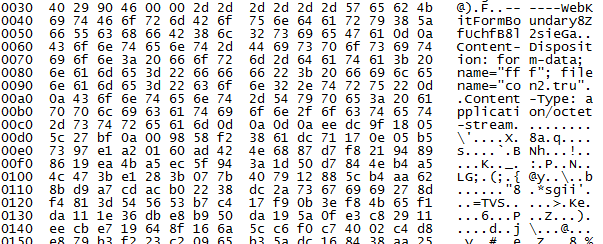
The next thing to do would be to update the code of their sniffers to detect this on the wire. I created a TrueCrypt container file and uploaded it. Here’s what I saw sniffing the packets. It’s a normal POST command, where this is the contents of the POST, starting at the “WebKitFormboundary”

The thing about TrueCrypt containers is that they are completely random. The first 8 bytes are random salt, followed by the encrypted contents of everything else. If they do it right, it’s impossible to distinguish TrueCrypt from purely random data (such as the output of /dev/urandom on Linux).

But luckily for us intelligence agents, TrueCrypt is rare in that property. Compressed files and encrypted ZIP files are also supposed to be random — except they have headers identifying themselves. They’ve all got non-random bits to them, so while I can’t easily identify TrueCrypt, I can easily identify everything that’s not TrueCrypt.

Thus, if the NSA has a sniffer eavesdropping next to these non-SSL file-upload sites, they can do the following. First of all, they can classify all known file types somebody would be uploading (images, movies, virus code, ZIP files, RAR files, etc.). Of the remaining, they would then apply a simple entropy measurement system that tests the randomness of a file. This will weed out things like text files, or anything else of an unknown format. (Back in the day, my intrusion prevent system did this — applying entropy tests to SSH and SSL connections once they were established, in order to discover exploits that would later send unencrypted data on these sessions, like the GOBBLES SSH exploit).

I have no experience eavesdropping on file upload sites, but I imagine the remaining files would be fairly small and manageable. Note that at this point, the NSA can start capturing the sessions so that later, when they capture terrorists and grab their keys, that they can decrypt old files. (This is one of the flaws of this terrorist dead-drop system: no “forward security”).

So these are the thoughts so far. I’m sure I’ll be tweeting back and forth with @thegrugq and will think of some more ideas. I’ll update this later.


Update: It would be the sniffers associated with the NSA’s XKeyScore system that would need to be updated to detect this. Presumably, this system can already track file uploads/downloads like this, and use file types as one of the search criteria when making queries.

One bit of code that would be useful to add to the sniffers would be some that automatically tried to password guess TrueCrypt container files. When it sees completely random bytes at the start of an upload, it can try to decrypt it using known passwords, and see if the result produces “TRUE” in the first few bytes, which is the string TrueCrypt uses to identify its files once decrypted. As passwords/passphrases are collected, they can be disseminated out to the sniffers, which can then identify these files in particular being transferred.


Notes: Instead of a keyfile used by the terrorists, I used a 5 lower-case letter password. You should be able to copy the bytes above into something that’ll crack the password.

Continue reading How to detect TrueCrypt blobs being passed around

Posted in Uncategorized

Comments on the FBI success in hacking Farook’s iPhone

Left-wing groups like the ACLU and the EFF have put out “official” responses to the news the FBI cracked Farook’s phone without help from the Apple. I thought I’d give a response from a libertarian/technologist angle.

First, thank you FBI for diligently trying to protect us from terrorism. No matter how much I oppose you on the “crypto backdoors” policy question, and the constitutional questions brought up in this court case, I still expect you to keep trying to protect us.
Likewise, thank you FBI for continuing to be open to alternative means to crack the phone. I suppose you could’ve wrangled things to ignore people coming forward with new information, in order to pursue the precedent, in the longer term policy battle. I disagree with the many people in my Twitter timeline who believe this was some sort of FBI plot — I believe it’s probably just what the FBI says it is: they first had no other solution, then they did.
Though, I do wonder if the FBI’s lawyers told them they would likely lose the appeal, thus setting a bad precedent, thus incentivizing the FBI to start looking for an alternative to get out of the case. Whether or not this is actually what happened, I do worry that government has all the power to pursue cases in such a way. It’s like playing poker against an opponent who, when they fold, gets all their chips back.

One precedent has been set, though: what it means to “exhaust all other options” therefore justifying the All Writs Act. From one perspective, the FBI was right that no old/existing technique existed to crack the phone. But their demand that only Apple could create a new technique was false. Somebody else obviously could create a new technique. I know a lot of people in the forensics, jailbreak, and 0day communities. They all confirm that the FBI never approached them to see if they could create a new technique. Instead, somebody created a new technique and approached the FBI on their own.

The next time the FBI attempts to conscript labor under the All Writs Act, I expect the judge to demand the FBI prove they haven’t tried to hire other engineers. In other words, the judge should ask “Did you contact VUPEN (an 0day firm) or @i0n1c (a jailbreaker) to see if they could create a solution for you?”.

Activists like the EFF are now demanding that the FBI make their technique public. This is nonsense. Whoever created the technique obviously wants to keep it secret so that Apple doesn’t patch it in the next iOS release. It’s probable that they gave the FBI Terms and Conditions such that they’d only provide a technique if it were kept secret. The only exception is if this were a forensics company like Cellebrite, which would then want to advertise the capability, to maximize revenue in the short period before Apple closes the hole. The point is, it’s the coder’s rights that are important here. It’s the coder who came up with the jailbreak/0day that gets to decide what to do with it.

Is the person/company who approached the FBI with the solution a hero or demon? On one hand, they’ve maintained the status quo, where Apple can continue to try to secure their phones, even against the FBI. On the other hand, they’ve forestalled the courts ruling in our favor, which many would have preferred. I don’t know the answer. Personally, had it been me, I’d’ve offered the exploit/jailbreak to the FBI, but at an exorbitant price they couldn’t afford, because I just don’t like the FBI.

Note: I doubt the technique was the NAND mirroring one many have described, or the well known “decapping” procedure that has a 30% of irretrievably destroying the data. Instead, I think it was an 0day or jailbreak. Those two communities are pretty large, and this is well within their abilities.

Also note: This is just my best guess, as somebody who does a lot of reverse engineering, coding, and hacking. I have little experience with iPhone in general. I write this blog because people keep asking me, not because I feel this is what everyone else should believe. The only thing I really stand behind here is “coder’s rights”, which is what the ACLU and EFF oppose.

The FBI needs to disclose this vulnerability to Apple. Right now. It’s irresponsible and dangerous not to.

— Amie Stepanovich (@astepanovich) March 29, 2016

DOJ: We’re not giving the iOS 0-day to Apple.
Apple: We will continue to help law enforcement in other cases.
Way to play hard ball, Apple.

— Christopher Soghoian (@csoghoian) March 29, 2016

Continue reading Comments on the FBI success in hacking Farook’s iPhone

Posted in Uncategorized

How the media really created Trump

This NYTimes op-ed claims to diagnose the press’s failings with regard to Trump, but in its first sentence demonstrates how little press understands the problem. The problem isn’t with Trump, but with the press.

The reason for Trump is that the press has discarded its principle of “objectivity”. Reasonable people disagree. The failing of the press is that they misrepresent one side, the Republicans, as being unreasonable. You see that in the op-ed above, where the very first sentence decries the “Republican Party’s toxic manipulation of racial resentments”. In fact, both parties are equally reasonable, or unreasonable as the case may be, with regards to race.

The article suggests the press should have done more to debunk Trump in the”form of fact checks and robust examination of policy proposals”. But the press doesn’t do that for Democrats, so why should a Republican candidate they don’t like get singled out? No amount of attacking Trump sticks because the press is blatantly unfair.

Hillary clearly is complicit in the “Benghazi” affair, because she led the charge to inject weapons into Libya to take down Ghadaffi, then ignored Chris Steven’s efforts to clean up the mess. Hillary’s use of her own email server was clearly an attempt to bypass transparency rules and conduct underhanded diplomacy, as the now public emails show. Yes, it’s true that there are some invalid Republican attacks on these issues that are blatantly partisan. But the press is less interested in holding Hillary accountable for these failures, and more interested in portraying Republicans as unreasonable by focusing on those partisan attacks.

Since the press doesn’t attack Obama or Hillary, the public will never see any attack against Trump as fair. The article points out that Politifact rates Trump as more dishonest than the other candidates. But that’s because it debunks virtually everything Trump says, while at the same time, not doing the same for Democrats. Populist rhetoric by any candidate should get the same treatment, but doesn’t. Trump is a populist demagogue, so of course what he says is going to have little relation to the truth, but nobody is going to believe this accusation when you are obviously so unfair about fact checking. Bernie is also a populist demagogue, but there’s little serious effort to debunk what he says.

These biases I mention are obvious to anybody outside the system. I’m a Libertarian, so I have equal disdain for both parties. In theory, Libertarians slightly favor the Republican rhetoric on the free market, but since Republican politicians never deliver on this, we slightly favor Democrat practical results on individual freedoms (e.g. acceptance of homosexuality). My point is that as somebody with some objectivity on the parties, the inability of the press to be objective is obvious to me.

Every time I bring this up, the press counters with “false balance“, a term they’ve concocted to justify their biases. So let’s pick the least partisan topic, that of “vaccines causing autism” to demonstrate the falseness of “false balance”.

To start with, we agree that there’s absolutely no link between vaccines and autism, and that the science is clear on this, and that only crazy/stupid people would think their is a link.

The thing is, the policy question is almost unrelated to the science question. Whatever the science says, the policy question is still whether the government can force people to get vaccines (or parents to vaccinate their child). There are two sides to this issue. On one side is the “choice” question of whether it’s a person’s choice what to do with their body. For example, in the abortion debate there is often the analogy of whether people can be forced to donate a kidney, or to give a bone marrow transplant. Moreover, while they don’t cause autism, vaccines do sometimes cause complications, so there is a risk (albeit tiny), to the person receiving the injection. On the other hand, vaccines are fundamentally unlike all other health issues, with vast benefits to be derived from “herd immunity” when everyone getting a vaccine. For example, the measles vaccine is imperfect, so when enough people shirk their duty to get vaccinated, even some vaccinated people may catch the disease.

The point being is that we have a clear, two-sided policy debate here, quite apart from the crazies.

More importantly is the way the press uses this issue to smear Republicans, in much the same way that I describe above with the way the NYTimes smear Republicans with race issues. Consider this story from CNN “Chris Christie sidesteps vaccine science“. All Christie said was, in response to the policy issue, that most of the time it’s the parent’s choice, which reporters unfairly extended to a position that “sidesteps science”. Obama’s spokesman said much the same thing only days prior to this event, but didn’t get smeared like Christie. In fact, whereas most candidates take the policy position that its always the parent’s choice, Christie took the position that sometimes the government can override parent’s choice when it’s important. But, that CNN article, and many other press articles at the time, smear Christie as somehow supporting anti-vaxxers.

The press likewise ignore Democrats on this issue, who pander just as much to the anti-vaxxers as any Republicans. In 2008, candidate Obama said “We’ve seen just a skyrocketing autism rate. Some people are suspicious that it’s connected to the vaccines. This person included“. Candidate Hillary said “I am committed to make investments to find the causes of autism, including possible environmental causes like vaccines“. The science was as clear then as it is now that there’s no link.

No politician (except Trump, of course) is on the anti-vax side, but at the same time, they don’t want to needlessly antagonize potential voters. Most take the policy position supporting parental/personal choice, but rather than condemning idiots/crazies for their bad science, simply say things like “well, as a parent, I get my kids vaccinated”. Trump, of course, goes full anti-vax, but once the press has already shown themselves to be corrupt and biased on this issue, what they say about Trump is no longer trusted.

Finally, let’s talk “science”. Members of the press stick up for the principles of science when it’s convenient and supports their beliefs, but otherwise attack science. Science says the same things about the autism-vaccine link as it does chiropractics, anti-oxidants, gluten-free, organic produce, and a whole lot of other subjects. The high-end grocery store Whole Foods is a shrine to anti-science, promoting all these things. Yet, many reporters I know shop at Whole Foods, for anti-oxidants and other nonsense.

Whether or not you judge somebody as an “anti-science crazy” that should be ignored because of “false balance” depends entirely upon which scientific issue you are discussing.

Thus, I’ve disproved your theory of “false-balance” three separate times here. Even while I agree that anti-vaxxers are crazy and shouldn’t be interviewed on the issue, I’ve nonetheless shown how the press is unable to deal with the either policy question or science question fairly, and moreover, uses this issue to unfairly smear politicians they don’t like.

It’s not just the anti-vax issue that is the problem. Pick any partisan “false balance” issue, and it’ll have the same problem of media bias, where they justify their corrupt behavior.

Half the population, even a large chunk of Democrats, agree with Trump’s idea that we should ban Muslims from coming into this country. I have as much distaste for this idea as you do, I hate it with unbridled passion. But here’s the thing: if half the population of the country believes a wrong thing, it’s by definition “reasonable”. It’s like in the old days when countries were split half-and-half between Protestantism and Catholicism. One side had to be wrong. They couldn’t accept the other half as reasonable, and took the scorched earth approach — literary scorching the fields during Europe’s religious wars that killed half the population. Today, there’s not a single Protestant on the Supreme Court, and nobody cares, because we’ve gotten past our differences. It’s where the term “bigotry” came from, about tolerating those who disagree with you.

The same logic applies here. Instead of suppressing Trump’s supporters on the farcical claim of “false balance”, let’s bring them out into the light and debate this issue like reasonable people. Shouting them down for being racists, as we do now, changes neither their minds nor their votes. Tolerating them as being reasonable (but wrong) people, as they certainly are, can change minds. Let’s discuss Muslims we know. Let’s discuss how America is the shining light throughout the world for people yearning to be free, and how we sully ourselves by closing borders. Let’s argue our point as if it has to stand on its own merits, rather than being our ideology.

Nicholas Kristof’s piece at the NYTimes lightly chides the press, for being too pure of heart to deal with the massive evil that is Trump. In truth, Trump is just an expression of the press’s evil nature. The press has suppressed and ignored a large section of the population. This has done nothing to change minds, and only caused grievances to fester, until a populist candidate came along. Had the press been less biased, less focused on attacking anybody of the wrong ideology, this anger would not have existed for Trump to tap into.


Note: When I was a kid, my father was a journalist. One day, I opened our front door to find two people in burgundy robes on our door step, members of the cult of Bagwan Shree Rajneesh. They weren’t there to convert us, but instead, had accepted my dad’s invitation to dinner (he was writing articles about the Rajneeshees). “But these people are crazy cultists!!”, I exclaimed to my father. He then gave me a lecture on unfair biases, and how just because I believed they were wrong, it didn’t mean they were unreasonable people we couldn’t have dinner with.

Continue reading How the media really created Trump

Posted in Uncategorized

I’m skeptical of NAND mirroring

Many have proposed “NAND mirroring” as the solution to the FBI’s troubles in recovering data from the San Bernadino shooter’s iPhone. Experts don’t see any problem with this approach, but that doesn’t mean experts know it will work, either. There are problems.
The problem is that iPhone’s erase the flash after 10 guesses. The solution is to therefore create a backup, or “mirror”, of the flash chips. When they get erased, just restore from backup, and try again.
The flaw with this approach is that it’s time consuming. After every 10 failed attempts, the chips need to be removed the phone, reflashed, and reinserted back into the phone. Then the phone needs to be rebooted.
For a 4-digit passcode, this process will need to be repeated a thousand times.This is doable in a couples of days. For a 6-digit passcode that is standard on iOS 9, this needs to be repeated 100,000 times, which will take many months of nonstop effort 24-hours a day. Presumably, you can make this more efficient by pipelining the process, using multiple sets of flash chips, so that a new fresh set can be swapped in within a few seconds, but it still takes a couple minutes for the iPhone to reboot.
Can an iPhone even reboot 100,000 times? Nobody knows. This is far beyond any quality assurance tests Apple does for their phones. Presumably, even this problem can be gotten around. If other components of the phone fail, in theory all you need is the CPU, which you can unsolder and stick into a new phone. Though, there may be complications, such as needing to also bring along the LTE baseband chip, because of security checks in the software.
This all assumes digits. If it’s an alphanumeric passcode, then everything just got exponentially harder.
The point is this: until somebody proves this technique actually works, it doesn’t. All experts agree it ought to work in theory, but there’s enough problems in practice that we should be a little skeptical of it as a viable solution for the FBI. As any expert will tell you, the difference between should work and does work is huge.
The next step is for somebody to prove it works for the 4-digit solution. It’s relatively straightforward as long as you have the equipment. That still won’t mean it’ll work for 6-digits/alphanumerics, but at least it would be a solid data point.


Update: [h/t @loon] Washington Post is reporting Comy saying (about NAND mirroring) during a news conference:

“I’ve heard that [method] a lot, It doesn’t work.”

Continue reading I’m skeptical of NAND mirroring

Posted in Uncategorized

There’s no conspiracy behind the FBI-v-Apple postponement

The FBI says it may have found another way to get data off an iPhone, and thus asked to postpone a hearing about whether Apple can be forced to do it. I thought I’d write a couple of comments. Specifically, people are looking for reasons to believe that the FBI, or Apple, or both are acting in bad faith, and that everything that happens is some sort of conspiracy. As far as I can tell, all evidence is that they are acting in good faith.

Orin Kerr writes:

If that happens, neither side will look good in the short term. The FBI won’t look good because it went to court and claimed it had no alternatives when an alternative existed. The whole case was for nothing, which will raise suspicions about why the government filed the case and the timing of this new discovery. But Apple won’t look good either. Apple claimed that the sky would fall if it had to create the code in light of the risk outsiders might steal it and threaten the privacy of everyone. If outsiders already have a way in without Apple’s help, then the sky has already fallen. Apple just didn’t know it.

I don’t agree.

It’s perfectly reasonable that alternatives for the FBI didn’t exist a few weeks ago, but exist now. Once the case hit the news, jailbreakers and 0day hackers could have looked for a bug to exploit, then created just the solution the FBI wants. They can do it in only a couple weeks, which would take Apple much longer, because they are vastly more motivated to do the work.

Conversely, Apple doesn’t claim the “sky will fall”. It only claims that developing a backdoor will make life easier for the hackers. Imagine that the hackers are charging the FBI $1 million. From Apple’s perspective, the sky hasn’t fallen, as the iPhone is safe from anybody who can’t afford $1 million. Conversely, if some tool leaked out on GitHub, so that anybody could download it, then relatively the sky will have fallen for Apple. The point is that this isn’t black-or-white, sky-falling issue, but one of a vast grey area somewhere in between.

Thus, the evidence is that both sides appear to be acting in good faith. The FBI exhausted all alternatives at the time, but then hackers created a new alternative. Apple doesn’t want to do anything more that could help those hackers.

The FBI and Apple are, of course, aware of how this one case fits into their long term plans. Thus, we know that what they say in public, and what they file in their briefs, have a larger agenda than just this case. But at the same time, the FBI could not have started this process if an alternative had been available at the time, or Apple would have contested the order by simply pointing out the alternative. That this didn’t happen means that both the FBI and Apple were unaware of a a better alternative. Thus, as far as I can tell, there’s no conspiracy here.

Continue reading There’s no conspiracy behind the FBI-v-Apple postponement

Posted in Uncategorized

Why we are upset with the NYTimes Paris terrorist article

On the Twitters, we’ve been mocking that NYTimes article on the Paris terrorists and how they used “encryption”. I thought I’d write up a brief note as to why.

It’s a typical example of yellow journalism. The public isn’t familiar with “encryption”, so it’s easy to sensationalize it, to make it seem like something sinister is going on.
At one point, the article says:

According to the police report and interviews with officials, none of the attackers’ emails or other electronic communications have been found, prompting the authorities to conclude that the group used encryption. What kind of encryption remains unknown, and is among the details that Mr. Abdeslam’s capture could help reveal.

That’s not how encryption works. Instead, if “encryption” were the one thing the terrorists were using to hide, then you’d certainly find encrypted emails and encrypted messages — ones you couldn’t read without knowing the key.
The lack of emails/messages instead hints that the terrorists were meeting in person, passing paper notes to each other, or using telepathy. All of these, even telepathy, are more likely explanation for the lack of evidence than “encryption”.
This article cites anonymous “authorities” here as concluding encryption was used. The New York Times has a long track record of abusing anonymous sources like this. Because we don’t know the identities of the authorities, there is no way to know if they are technically competent to come to such a conclusion or whether they have a political ax to grind. There is no way to challenge who made that conclusion.
But in this case, we do know that the source of this quote is political. Law enforcement wants backdoors in crypto to further their own power. They want to scare the public into accepting backdoors by tying “terrorists” to “encryption”. That’s what frustrates us about this NYTimes article. It repeats the government’s talking points without itself challenging the government, and without citing the source allowing the rest of us to challenge the government.
The truth about encryption is that it’s baked into everything we do on the Internet. You are probably using encryption right now when reading this blog post. The terrorists probably used encryption whenever they used the Internet without knowing about it. It exists because without it, hackers would be breaking into everything we do on the Internet. Even if the terrorists used a privacy-focused chat app like Wickr, the salient feature of that app is that it auto deletes messages after a time, not that its encryption is anything better than that baked into everything else.
So yes, after a fashion, it’s true that the terrorists used “encryption” at one point. But this isn’t the story. The story is that the terrorists were very good at “opsec”, avoiding intelligence services spying on them, such as meeting in person, or if using the Internet, avoiding standard messaging systems that would reveal “metadata”, such as the existence of secret messages between them. That’s the story — not that they are using something like PGP encrypted email (which would normally leave evidence), but they successfully hid that fact from the police.
Or, if you want it from the other direction, it’s a story about intelligence failures, since the terrorists were well-known, including their leader being quoted in terrorist magazines as wanting to carry out terrorist attacks. Hindsight is 20/20, so I’m loathe to criticize intelligence services for missing the obvious, but there sure is a ton of obvious clues that they missed. So much un-encrypted evidence existed that you can’t blame encryption as the cause.
So this is why we are angry at this NYTimes article. Government wants encryption backdoors. Government will tie any terrorist attack to encryption. The NYTimes repeats the government talking point without questioning them. Worse, by keeping it’s sources anonymous, it prevents the rest of us from challenging them. While we can’t challenge the sources, we can point to the obvious logic errors, as I do in the quote above. But even this doesn’t work, as the journalist insists there’s some additional data they have that makes it all work out, data they can’t share with us, of course.

Continue reading Why we are upset with the NYTimes Paris terrorist article

Posted in Uncategorized