NonPetya: no evidence it was a “smokescreen”

Many well-regarded experts claim that the not-Petya ransomware wasn’t “ransomware” at all, but a “wiper” whose goal was to destroy files, without any intent at letting victims recover their files. I want to point out that there is no real evidence of this.

Certainly, things look suspicious. For one thing, it certainly targeted the Ukraine. For another thing, it made several mistakes that prevent them from ever decrypting drives. Their email account was shutdown, and it corrupts the boot sector.

But these things aren’t evidence, they are problems. They are things needing explanation, not things that support our preferred conspiracy theory.

The simplest, Occam’s Razor explanation explanation is that they were simple mistakes. Such mistakes are common among ransomware. We think of virus writers as professional software developers who thoroughly test their code. Decades of evidence show the opposite, that such software is of poor quality with shockingly bad bugs.

It’s true that effectively, nPetya is a wiper. Matthieu Suiche‏ does a great job describing one flaw that prevents it working. @hasherezade does a great job explaining another flaw.  But best explanation isn’t that this is intentional. Even if these bugs didn’t exist, it’d still be a wiper if the perpetrators simply ignored the decryption requests. They need not intentionally make the decryption fail.

Thus, the simpler explanation is that it’s simply a bug. Ransomware authors test the bits they care about, and test less well the bits they don’t. It’s quite plausible to believe that just before shipping the code, they’d add a few extra features, and forget to regression test the entire suite. I mean, I do that all the time with my code.

Some have pointed to the sophistication of the code as proof that such simple errors are unlikely. This isn’t true. While it’s more sophisticated than WannaCry, it’s about average for the current state-of-the-art for ransomware in general. What people think of, such the Petya base, or using PsExec to spread throughout a Windows domain, is already at least a year old.

Indeed, the use of PsExec itself is a bit clumsy, when the code for doing the same thing is already public. It’s just a few calls to basic Windows networking APIs. A sophisticated virus would do this itself, rather than clumsily use PsExec.

Infamy doesn’t mean skill. People keep making the mistake that the more widespread something is in the news, the more skill, the more of a “conspiracy” there must be behind it. This is not true. Virus/worm writers often do newsworthy things by accident. Indeed, the history of worms, starting with the Morris Worm, has been things running out of control more than the author’s expectations.

What makes nPetya newsworthy isn’t the EternalBlue exploit or the wiper feature. Instead, the creators got lucky with MeDoc. The software is used by every major organization in the Ukraine, and at the same time, their website was horribly insecure — laughably insecure. Furthermore, it’s autoupdate feature didn’t check cryptographic signatures. No hacker can plan for this level of widespread incompetence — it’s just extreme luck.

Thus, the effect of bumbling around is something that hit the Ukraine pretty hard, but it’s not necessarily the intent of the creators. It’s like how the Slammer worm hit South Korea pretty hard, or how the Witty worm hit the DoD pretty hard. These things look “targeted”, especially to the victims, but it was by pure chance (provably so, in the case of Witty).

Certainly, MeDoc was targeted. But then, targeting a single organization is the norm for ransomware. They have to do it that way, giving each target a different Bitcoin address for payment. That it then spread to the entire Ukraine, and further, is the sort of thing that typically surprises worm writers.

Finally, there’s little reason to believe that there needs to be a “smokescreen”. Russian hackers are targeting the Ukraine all the time. Whether Russian hackers are to blame for “ransomware” vs. “wiper” makes little difference.

Conclusion

We know that Russian hackers are constantly targeting the Ukraine. Therefore, the theory that this was nPetya’s goal all along, to destroy Ukraines computers, is a good one.

Yet, there’s no actual “evidence” of this. nPetya’s issues are just as easily explained by normal software bugs. The smokescreen isn’t needed. The boot record bug isn’t needed. The single email address that was shutdown isn’t significant, since half of all ransomware uses the same technique.

The experts who disagree with me are really smart/experienced people who you should generally trust. It’s just that I can’t see their evidence.


Update: comment asks “why is there no Internet spreading code?”. The answer is “I don’t know”, but unanswerable questions aren’t evidence of a conspiracy. “What aren’t there any stars in the background?” isn’t proof the moon landings are fake, such because you can’t answer the question. One guess is that you never want ransomware to spread that far, until you’ve figured out how to get payment from so many people.

Continue reading NonPetya: no evidence it was a “smokescreen”

Posted in SBN

More notes on US-CERTs IOCs

Yet another Russian attack against the power grid, and yet more bad IOCs from the DHS US-CERT.

IOCs are “indicators of compromise”, things you can look for in order to order to see if you, too, have been hacked by the same perpetrators. There are several types of IOCs, ranging from the highly specific to the uselessly generic.

A uselessly generic IOC would be like trying to identify bank robbers by the fact that their getaway car was “white” in color. It’s worth documenting, so that if the police ever show up in a suspected cabin in the woods, they can note that there’s a “white” car parked in front.

But if you work bank security, that doesn’t mean you should be on the lookout for “white” cars. That would be silly.

This is what happens with US-CERT’s IOCs. They list some potentially useful things, but they also list a lot of junk that waste’s people’s times, with little ability to distinguish between the useful and the useless.

An example: a few months ago was the GRIZZLEYBEAR report published by US-CERT. Among other things, it listed IP addresses used by hackers. There was no description which would be useful IP addresses to watch for, and which would be useless.

Some of these IP addresses were useful, pointing to servers the group has been using a long time as command-and-control servers. Other IP addresses are more dubious, such as Tor exit nodes. You aren’t concerned about any specific Tor exit IP address, because it changes randomly, so has no relationship to the attackers. Instead, if you cared about those Tor IP addresses, what you should be looking for is a dynamically updated list of Tor nodes updated daily.

And finally, they listed IP addresses of Yahoo, because attackers passed data through Yahoo servers. No, it wasn’t because those Yahoo servers had been compromised, it’s just that everyone passes things though them, like email.

A Vermont power-plant blindly dumped all those IP addresses into their sensors. As a consequence, the next morning when an employee checked their Yahoo email, the sensors triggered. This resulted in national headlines about the Russians hacking the Vermont power grid.

Today, the US-CERT made similar mistakes with CRASHOVERRIDE. They took a report from Dragos Security, then mutilated it. Dragos’s own IOCs focused on things like hostile strings and file hashes of the hostile files. They also included filenames, but similar to the reason you’d noticed a white car — because it happened, not because you should be on the lookout for it. In context, there’s nothing wrong with noting the file name.

But the US-CERT pulled the filenames out of context. One of those filenames was, humorously, “svchost.exe”. It’s the name of an essential Windows service. Every Windows computer is running multiple copies of “svchost.exe”. It’s like saying “be on the lookout for Windows”.

Yes, it’s true that viruses use the same filenames as essential Windows files like “svchost.exe”. That’s, generally, something you should be aware of. But that CRASHOVERRIDE did this is wholly meaningless.

What Dragos Security was actually reporting was that a “svchost.exe” with the file hash of 79ca89711cdaedb16b0ccccfdcfbd6aa7e57120a was the virus — it’s the hash that’s the important IOC. Pulling the filename out of context is just silly.

Luckily, the DHS also provides some of the raw information provided by Dragos. But even then, there’s problems: they provide it in formatted form, for HTML, PDF, or Excel documents. This corrupts the original data so that it’s no longer machine readable. For example, from their webpage, they have the following:

import “pe”
import “hash”

Among the problems are the fact that the quote marks have been altered, probably by Word’s “smart quotes” feature. In other cases, I’ve seen PDF documents get confused by the number 0 and the letter O, as if the raw data had been scanned in from a printed document and OCRed.

If this were a “threat intel” company,  we’d call this snake oil. The US-CERT is using Dragos Security’s reports to promote itself, but ultimate providing negative value, mutilating the content.

This, ultimately, causes a lot of harm. The press trusted their content. So does the network of downstream entities, like municipal power grids. There are tens of thousands of such consumers of these reports, often with less expertise than even US-CERT. There are sprinklings of smart people in these organizations, I meet them at hacker cons, and am fascinated by their stories. But institutionally, they are dumbed dow the same level as these US-CERT reports, with the smart people marginalized.

There are two solutions to this problem. The first is that when the stupidity of what you do causes everyone to laugh at you, stop doing it. The second is to value technical expertise, empowering those who know what they are doing. Examples of what not to do are giving power to people like Obama’s cyberczar, Michael Daniels, who once claimed his lack of technical knowledge was a bonus, because it allowed him to see the strategic picture instead of getting distracted by details.

Continue reading More notes on US-CERTs IOCs

Posted in SBN

How The Intercept Outed Reality Winner

Today, The Intercept released documents on election tampering from an NSA leaker. Later, the arrest warrant request for an NSA contractor named “Reality Winner” was published, showing how they tracked her down because she had printed out the documents and sent them to The Intercept. The document posted by the Intercept isn’t the original PDF file, but a PDF containing the pictures of the printed version that was then later scanned in.

The problem is that all new printers print nearly invisibly yellow dots that track down exactly when and where documents, any document, is printed. Because the NSA logs all printing jobs on its printers, it can use this to match up precisely who printed the document.

In this post, I show how.

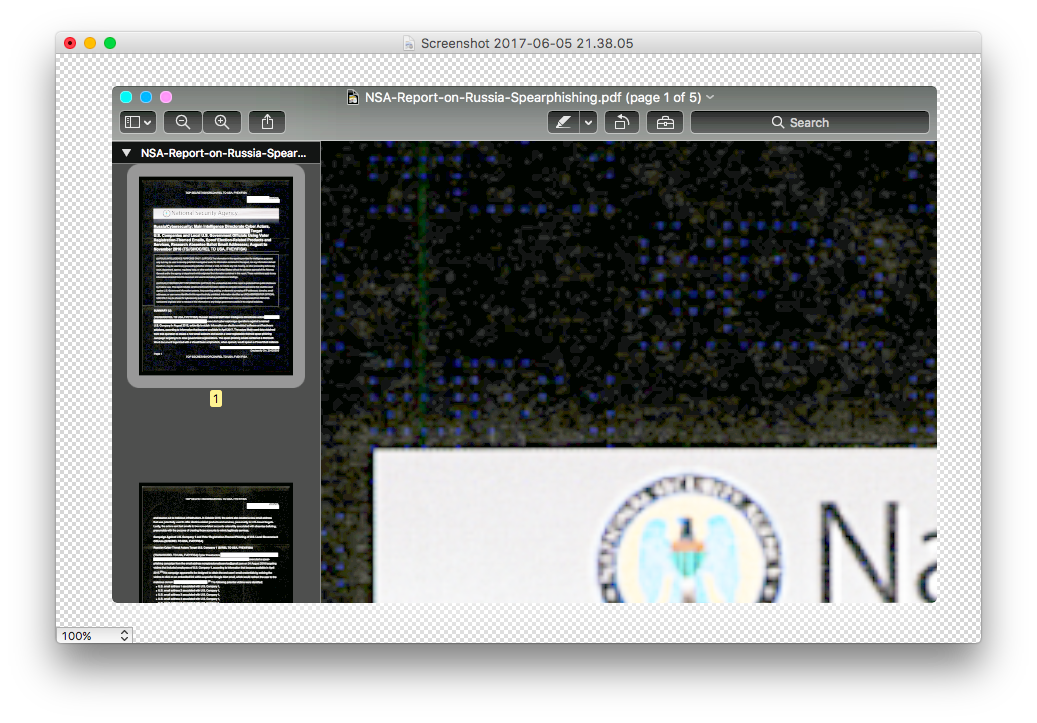
You can download the document from the original article here. You can then open it in a PDF viewer, such as the normal “Preview” app on macOS. Zoom into some whitespace on the document, and take a screenshot of this. On macOS, hit [Command-Shift-3] to take a screenshot of a window. There are yellow dots in this image, but you can barely see them, especially if your screen is dirty.

We need to highlight the yellow dots. Open the screenshot in an image editor, such as the “Paintbrush” program built into macOS. Now use the option to “Invert Colors” in the image, to get something like this. You should see a roughly rectangular pattern checkerboard in the whitespace.

It’s upside down, so we need to rotate it 180 degrees, or flip-horizontal and flip-vertical:

Now we go to the EFF page and manually click on the pattern so that their tool can decode the meaning:

This produces the following result:

The document leaked by the Intercept was from a printer with model number 54, serial number 29535218. The document was printed on May 9, 2017 at 6:20. The NSA almost certainly has a record of who used the printer at that time.

The situation is similar to how Vice outed the location of John McAfee, by publishing JPEG photographs of him with the EXIF GPS coordinates still hidden in the file. Or it’s how PDFs are often redacted by adding a black bar on top of image, leaving the underlying contents still in the file for people to read, such as in this NYTime accident with a Snowden document. These sorts of failures are common with leaks. To fix this yellow-dot problem, use a black-and-white printer, black-and-white scanner, or convert to black-and-white with an image editor.

Printers have two features put in there by the government to be evil to you. The first is that they recognize a barely visible pattern on currency, so that they can’t be used to counterfeit money, as shown on this $20 below:

The second is that when they print things out, they includes these invisible dots, so documents can be tracked.

Yes, this code the government forces into our printers is a violation of our 3rd Amendment rights.


While I was writing up this post, these tweets appeared first:

oh wow, @knowtheory just pointed out the microdots on the first and late page of the intercept’s docs. printer dots kill puppies, folks. pic.twitter.com/w8qxJ9zvhf

— Quinn’s internet 👻 (@quinnnorton) June 6, 2017

The date in the microdots is 6:20 2017/05/09 from a printer with serial number #5429535218, according to https://t.co/PVVm7AAjlL pic.twitter.com/6BY7Y3MFhL

— Tim Bennett (@flashman) June 6, 2017

Continue reading How The Intercept Outed Reality Winner

Posted in SBN