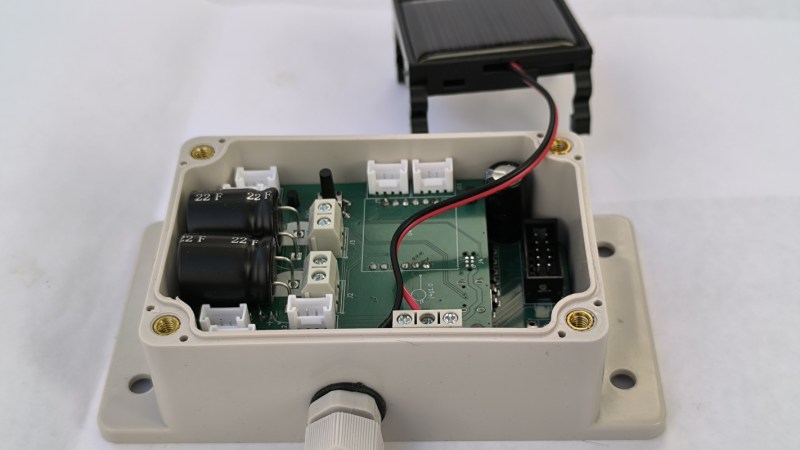
With all the battery technologies and modern low-current sleep modes in most microcontrollers, running a sensor and microcontroller combo off-grid and far away from any infrastructure is usually not too difficult a task. Often these sorts of systems can go years without maintenance or interaction. But for something that still has to be off-grid but needs to do some amount of work every now and then like actuating a solenoid or quickly turning a servo, these battery-based systems can quickly run out of juice. To solve that problem, [Nelectra] has come up with this high-power capacitor-based IoT system.
Although supercapacitors don’t tend to have the energy density of batteries, they’re perfectly capable of powering short tasks in off-grid situations like this. They’re also typically able to tolerate lower voltages, extreme temperatures, and shock better than most batteries as well. A small solar cell on the top of this device keeps it topped up, and when running in deep sleep mode can hold a charge for up to six days. In more real-world applications supporting sensors, relays, or other actuators, [Nelectra] has found that it can hold a charge for around three days. When a quick burst of power is needed, it can deliver 1.5 A at 9 V or 500 mA at 24 V.
[Nelectra]’s stated goal for this build is to bridge low-power energy harvesting and practical field actuation, enabling maintenance-free systems such as irrigation control and remote switching without batteries, going beyond simple sensor applications while not relying on always-on power from somewhere else. Something like this would work really well in applications like this automated farm, which has already provided some unique solutions to intermittent power and microcontroller applications that need very high reliability.
